
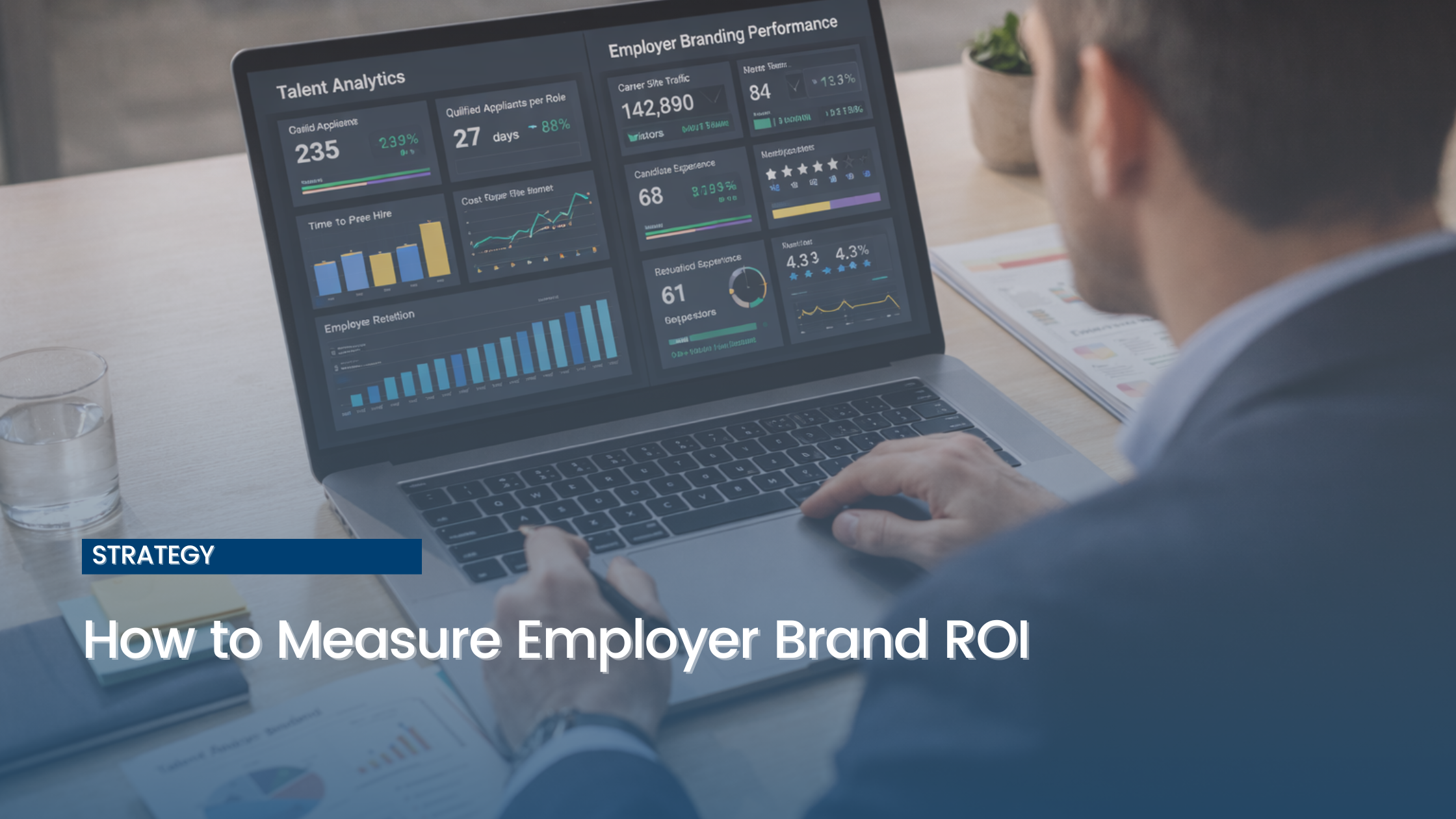
Employer branding has become one of the most important investments organizations make to attract and retain talent. Yet one of the most common questions employer brand leaders hear from executives is:
“How do we measure the ROI of employer branding?”
Unlike traditional recruitment metrics like time-to-fill or cost-per-hire, employer branding can feel harder to quantify. But the reality is that a strong employer brand has a measurable impact across the entire talent lifecycle—from candidate attraction to employee retention.
To understand employer brand ROI, organizations must look at a combination of talent acquisition metrics, brand perception metrics, and long-term workforce outcomes.
Here’s how to measure the impact of your employer branding strategy.
1. Track Quality of Applicants
One of the clearest signals of a strong employer brand is the quality of candidates applying to your roles.
When employer branding improves, organizations typically see:
- More qualified candidates applying
- Better alignment between candidate expectations and company culture
- Higher conversion rates throughout the hiring process
Metrics to track
- Qualified applicants per role
- Application-to-interview rate
- Interview-to-offer rate
If your employer branding strategy is working, your recruiting team should spend less time filtering unqualified candidates and more time engaging high-quality talent.
2. Measure Cost Per Hire
A strong employer brand reduces the amount companies need to spend on job advertising, agencies, and sourcing tools.
Companies with well-known employer brands often attract candidates organically through their reputation, employee referrals, and social media presence.
Metrics to track
- Cost per hire
- Agency spend
- Job advertising spend
- Sourcing tool usage
Over time, companies with strong employer brands typically see lower acquisition costs and more inbound candidate interest.
3. Monitor Time to Fill
Employer branding can significantly reduce time-to-fill by increasing awareness and interest in your company.
Candidates who are already familiar with your organization are more likely to apply quickly and move through the hiring process faster.
Metrics to track
- Time to fill
- Time to accept offer
- Candidate pipeline health
Organizations with strong employer brands often maintain more consistent talent pipelines, making hiring faster and easier.
4. Track Career Site and Content Engagement
Employer branding increasingly relies on content—career pages, social media posts, employee stories, and recruitment marketing campaigns.
Tracking how candidates interact with this content provides insight into brand awareness and engagement.
Metrics to track
- Career site traffic
- Time spent on career pages
- Job page conversion rates
- Employer brand social media engagement
If your employer brand content is resonating, you should see increased engagement and candidate interaction over time.
5. Monitor Candidate Experience Scores
Candidate experience plays a major role in employer brand perception.
Even candidates who aren’t hired can become advocates—or critics—depending on their experience during the hiring process.
Metrics to track
- Candidate satisfaction surveys
- Candidate Net Promoter Score (cNPS)
- Interview feedback
- Offer acceptance rates
A positive candidate experience strengthens employer brand reputation and increases the likelihood that candidates will recommend your company to others.
6. Measure Employee Retention and Engagement
Employer branding doesn’t stop once someone is hired. In fact, a strong employer brand must reflect the actual employee experience.
If the brand promise matches reality, organizations often see higher employee engagement and retention.
Metrics to track
- Employee retention rates
- Employee engagement scores
- Internal mobility rates
- Employee Net Promoter Score (eNPS)
When employer branding aligns with internal culture, employees are more likely to stay and advocate for the company externally.
7. Monitor Employer Reputation
Employer reputation across platforms like job review sites and social media provides valuable insight into how your brand is perceived by both candidates and employees.
Metrics to track
- Employer review site ratings
- Review sentiment trends
- Social media mentions
- Share of voice compared to competitors
Tracking reputation over time helps organizations understand how employer brand perception is evolving.
Employer branding ROI isn’t measured by a single metric. Instead, it’s the combined impact of multiple indicators across the talent lifecycle.
Organizations that successfully measure employer branding typically track metrics across three key areas:
Talent acquisition performance
- Candidate quality
- Cost per hire
- Time to fill
Candidate engagement
- Career site traffic
- Content engagement
- Candidate experience
Workforce outcomes
- Retention
- Employee engagement
- Employer reputation
When these metrics improve over time, it becomes clear that employer branding is not just a marketing initiative—it’s a strategic investment that drives measurable business results.
For organizations competing for top talent, the question is no longer whether employer branding matters.
The real question is how effectively it’s being measured and optimized.
Leave a Reply